India’s Silent Revolution: Redistribution through Unconditional Cash Transfers to Women
New research assesses the impacts of India’s Unconditional Cash Transfer (UCT) program as a vehicle for recognizing women’s care labors.
A silent revolution is underway in India today. Since 2020, 13 states have rolled out Unconditional Cash Transfers (UCTs) to approximately 120 million women comprising 17% of India’s female population. The transfers, which range from Rs. 830 ($8.70) to Rs. 2500 ($26.19) constitute anywhere between 5-12% of average monthly household income. UCTs have become a key plank of election promises in several state assembly elections in the past five years, with one state (Delhi) due to implement UCTs from the end of August 2026 and two states (Andhra Pradesh and Telangana) which have promised UCTs to women and are yet to roll them out. UCTs have been the subject of heated debate, with accusations that “freebies for votes” will lead to fiscal distress.
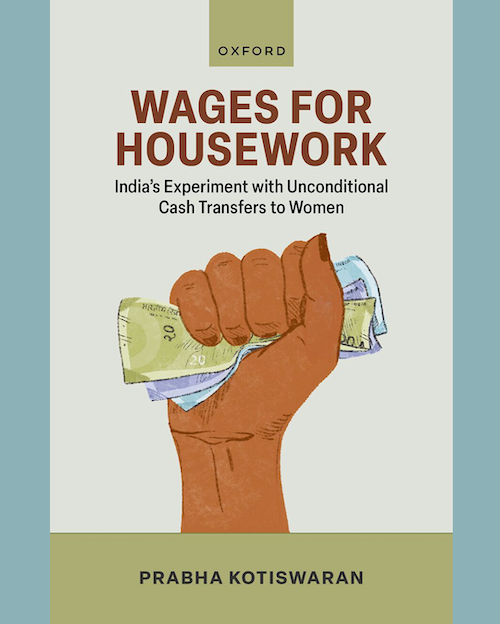
Feminists, meanwhile, have been deeply skeptical of UCTs, expressing concerns that they disincentivize women’s education and entry into paid employment, even while reinforcing the gendered division of labor. In my new open-access book Wages for Housework: India’s Experiment with Unconditional Cash Transfers to Women (Oxford University Press, 2026) which is part of the Laws of Social Reproduction project, I argue that, while we have reason to be skeptical, UCTs are a welcome redistributive move in favor of women. Set against the backdrop of a low female labor-force participation rate, a weak welfare regime and an entrenched culture of gendered familialism, the book engages with the arguments made for and against UCTs by feminist economists and welfare theorists.
The first chapter offers an overview of the international Wages for Housework campaign as it has emerged in the West and its reception in India. Even as social reproduction feminism became more visible in the aftermath of the pandemic, India’s relatively low female labor-force participation rate rendered it somewhat distinctive. Indian feminist economists have offered numerous explanations for this phenomenon, which became the backdrop when feminists debated UCTs as an electoral issue in 2021. Setting out the arguments for and against UCTs helps make a case for them as a valuable experiment in the Indian context.
My feminist theorization of the postcolonial welfare regime explains how early female nationalist leaders aspired for both men and women to engage in paid work and care work even while insisting that the state offer economic recognition of unpaid work. A look at India’s welfare regime for women seven decades after independence concludes that, while basic and paternalistic, UCTs signal a positive refashioning of gendered social and marital contracts.
While nationalist feminists articulated their aspirations for the economic role of Indian women on the eve of independence (effectively “wages for housework” thinking), Indian courts gave specific expression to wages for housework jurisprudence in the post-independence period. I analyze an extensive database of cases adjudicated under the Motor Vehicles Act of 1988 pertaining to homemakers killed in motor vehicles accidents to show how Indian appellate courts began to recognize women’s unpaid work as being on par with a paid occupation for purposes of compensation to their dependents. I consider the distributive effects of this jurisprudence and the confirmation by the Indian Supreme Court of this jurisprudence since 2010.
Having made a normative case for UCTs, the book offers an in-depth study of their implementation in three states: Goa, Assam and West Bengal. I trace these subnational welfare regimes from a feminist perspective through interviews with various stakeholders including politicians, bureaucrats, feminists and female beneficiaries themselves, asking if and how UCTs have resulted in women’s empowerment. I find that UCTs in these states did not disincentivize investment in education or women’s paid work nor did they reinforce the gendered division of labor. While they offered dignity and empowerment, they did not lessen the burdens of unpaid work performed by women.
The interdisciplinary Laws of Social Reproduction project continued this research by carrying out mixed-methods causal analysis of the UCTs in two other states, Tamil Nadu and Karnataka. Based on focus-group discussions with beneficiaries and interviews with bureaucrats and officials implementing the UCT schemes, we designed a survey tool that we used to survey 2,000 women in each state including 1,200 beneficiaries and 800 non-beneficiaries across several districts to measure the treatment effect on a range of outcome variables including expenditure patterns, financial inclusion, access to financial infrastructure, financial wellbeing, food consumption at individual and household levels, women’s paid and unpaid work, intra-household bargaining power and intimate partner violence. We catalogue our research and that of research studies in other states in a national-level policy brief covering the 13 states implementing UCTs and find no evidence that UCTs disincentivize education or paid employment or reinforce the gendered division of labour. Hence even while feminist debates on the desirability of UCTs are important, they provide an unprecedented political opportunity to engage with governments and advocate for gender-transformative UCTs bearing these caveats and recommendations in mind:
Adopt a Gender-Sensitive Programme Design
Keep UCTs unconditional by avoiding eligibility criteria such as the number of children or maintenance of children’s health status, which are typically onerous for women to meet. Make access to UCTs independent of marital status, as barring never-married women reinforces gendered norms around compulsory marriage. Make UCTs trans-inclusive and inclusive of gender non-conforming minorities. Avoid naming UCT schemes in ways that indicate familial relationships (Ladki Bahin / “Dear Sister” scheme or Maiya Samman Yojana /“Respect for Mothers” scheme) that reinforce gendered identities and expectations. State must instead adopt names that promote rights claims, as in the state of Tamil Nadu. Women should have complete autonomy over the use of UCT monies. Governments must encourage savings habits through messaging rather than mandate, amplifying the truly unconditional nature of UCTs and promoting women’s autonomy.
Adopt a Systemic and Long-Term Approach to Achieving the Goals of UCTs
Going beyond electoral outcomes, governments must have a clearly stated and specific rationale for UCTs that is effectively communicated to beneficiaries. Social messaging on UCTs as a means to recognize, reduce, and redistribute unpaid domestic and care work (UDCW) should be improved. Governments should facilitate the mobilization of beneficiaries themselves through non-governmental organizations to sustain the long-term realization of UCT goals. They should make proactive efforts to improve women’s financial literacy (regarding savings, loans and investments, and bank procedures), enable access to financial infrastructure, and offer training on how to avoid predatory lending that can lead to the feminization of debt. Investment in adult-learning opportunities for women to improve numeracy and literacy skills is also necessary.
Recognize, Reduce, and Redistribute Unpaid Domestic and Care Work
UCTs have not yet led to a dramatic shift in the social recognition, reduction, or redistribution of UDCW, although several states do offer either implicit or explicit recognition of it, in line with Sustainable Development Goal (SDG) 5.4 (United Nations Department of Economics and Social Affairs 2025). This recognition by political parties, irrespective of their ideology, is an opportunity to take seriously the gender-transformative potential of UCTs in realizing the goals of SDG 5.4. Women’s groups and feminists must leverage this occasion to shape the terms on which UCTs are implemented through consistent dialogue with political parties and bureaucrats as well as through advocacy campaigns and strategic litigation.
Adopt a Rights-Based Approach to Care
Recognize and protect the rights of paid care workers, whether in nursing, education, teaching, scheme work (Accredited Social Health Activists, Anganwadi or creche workers and helpers), domestic work, childcare, or elder care. Similarly, the state must recognize women’s UDCW performed within the family through a regime of matrimonial property and fair and equitable division of assets on divorce.
Rethink Welfare from a Rights Perspective
The state must embed women’s right to economic recognition of their UDCW through UCT payments in national and state legislation, so that these rights are secured for long-term impact despite changes in political dispensation (UN Women 2019). After all, the Indian Supreme Court has, in 2010, 2021 and 2026, reiterated the constitutional obligation to recognize women’s UDCW thereby constitutionalizing the value of social reproduction. There must be periodic consultations on the implementation of UCTs with beneficiaries, women’s wings of political parties, civil society groups, women’s organizations, and gender experts.
Address Macro-Economic Challenges
While UCTs are valuable interventions in expanding the welfare regime in favor of women, there is also a need to enhance women’s access to decent employment opportunities, including home-based employment, especially in rural areas. Our research showed that women consistently worry about employment opportunities for youth. The state must also enforce laws against all usurious and predatory lending practices, especially those considered microfinance. Women expressed anguish at the damage that alcoholism caused to their lives and communities, dramatizing the need to review the regulation of the alcohol industry and promote responsible drinking. Finally, it is important to remember that UCTs are not a substitute for increased public investment in education and health infrastructure.
Conclusion
Given the low female participation rate in paid employment, the home remains the key site of labor for most women, a contributor to their economic precarity. By putting money in their hands, UCTs pave the path to a welfare regime that can assure a woman of an autonomous household, without having to rely on marriage to maintain herself and her dependents. I argue that UCTs represent an unprecedented and welcome expansion of the Indian welfare regime, but, for them to be truly gender transformative, they must be embedded in a broader feminist agenda. My discussion of India’s jurisprudence makes a case for an Indian care manifesto to embed the rights of women who perform reproductive labor to realize the Constitution’s promise of equality. To the extent that UCTs recognize women’s UDCW in explicit and implicit terms, they can inaugurate cultural shifts in the gendered division of labor—for recognition must precede its reduction and redistribution. Based on this recognition, we can secure the right to care and the rights of carers. In the future, the care work of men can also be recognized through UCTs. In fact, women we met would often suggest that poor men receive UCTs. Although UCTs in most states are means-tested, women in our research also wanted wealthier women to receive the transfer given their lack of access to family income and assets. UCTs can be further linked to livelihood options. Consistent feminist advocacy to make UCTs gender-transformative can contribute to addressing the deeply embedded vulnerabilities and inequalities that Indian women face.
Prabha Kotiswaran is a Professor of Law and Social Justice at King’s College London.
This work is licensed under a Creative Commons Attribution-NonCommercial-NoDerivatives 4.0 International License.