When care becomes infrastructure: community solidarity against gender violence in urban Mexico
In the outskirts of León, Guanajuato, where state institutions fall short, women have built community care networks that function as everyday infrastructure for surviving poverty and gender-based violence. Their practices are not perfect, but they make life liveable.
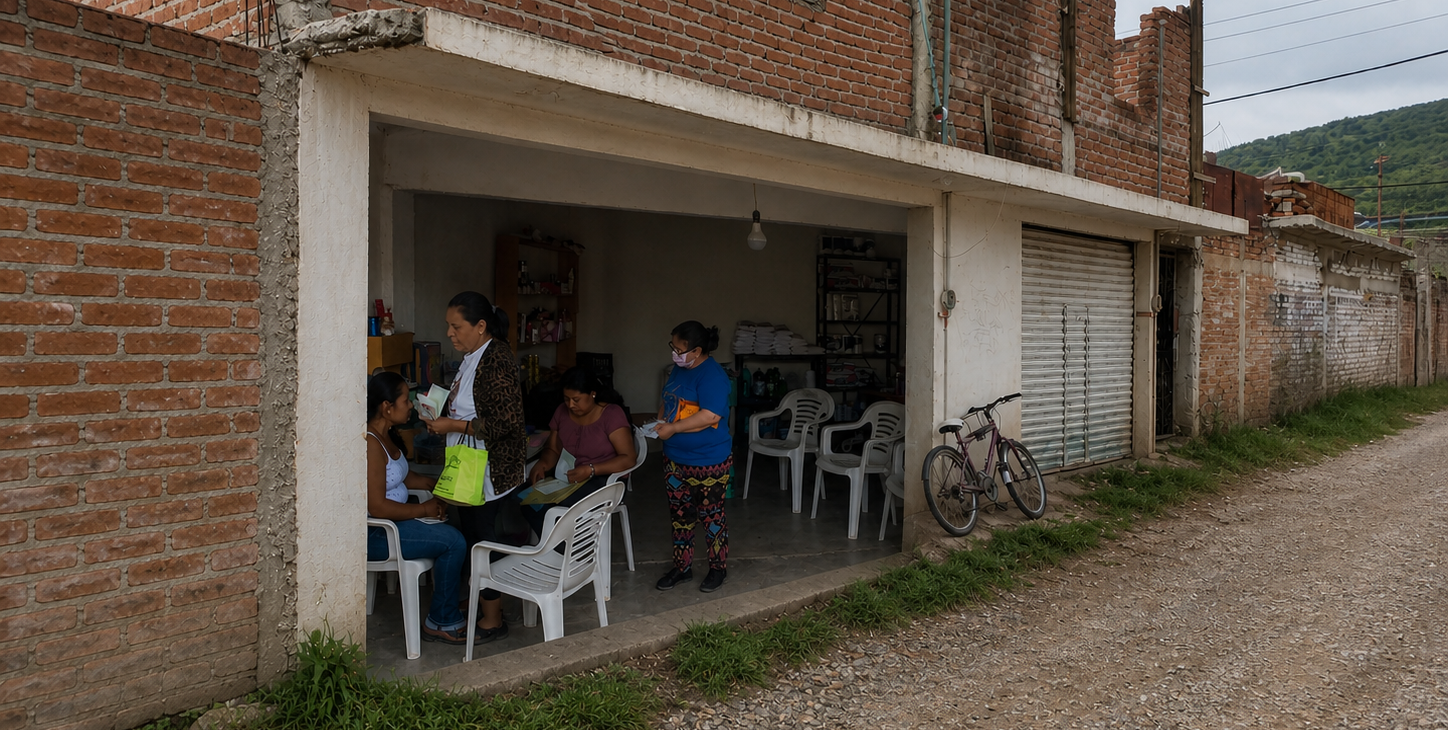
On the edge of León, Guanajuato, one of Mexico’s industrial powerhouses, lies the Polígono de Los Castillos. It is a cluster of roughly 70 neighborhoods where nearly 74,000 people live with limited paving, scarce public services, and persistent poverty. Almost half the population of the state of Guanajuato lives in poverty, and rates of sexual violence and domestic violence have risen sharply over recent years. For many women in the colonia Nuevo León, at the heart of this polygon, these two realities are not separate problems. They are the same daily experience.
My doctoral research brought me to this territory between 2021 and 2022, in the immediate aftermath of the COVID-19 pandemic. I was looking for something that policy documents rarely capture, the popular, collective, and often invisible work that women do to sustain life when the state is absent or insufficient. What I found were two women-led organizations that offer a powerful lesson about the meaning of care and its limits.
The first is a solidarity savings and lending group, founded in 2011 through connections with a local human rights organization. Every week, a group of women comes together to pool small amounts of money, access interest-free loans, and make collective purchases.
The economic dimension is clear. Women gain access to resources outside the control of partners, avoid predatory lenders, and can cover urgent household expenses. But reducing the group to its financial function misses something essential. As one participant explained “it operates as a reason to gather, a space to meet regularly, save together, and begin to identify women’s economic needs such as food, autonomy, and control over their own money”.
In practice, the group is both an economic strategy and a space of emotional support.
The second organization, a collective focused on bodily care and listening, emerged from the savings group in 2018. Drawing on knowledge passed down from mothers and grandmothers, along with earlier training from a nun who had lived in the neighborhood since 1997, its members offer massage, natural therapies, and attentive listening to women in the community.
They began in a simple way, inviting women in public spaces to sit down for a few minutes and receive a small massage. The effects, however, went far beyond what might be expected from such a modest gesture. Again and again, women came in with a pain in their back or stomach, and left having named something else entirely, such as the tension of living with a partner who controls them, the fear of conflict, the exhaustion of chronic stress. “Their faces change, their gaze, their smile,” one collective member told me. The body becomes a place where violence leaves its trace, but also where healing, even if partial, can begin.
From a feminist economics perspective, what these two organizations are building is what I would call a community care infrastructure. A set of practices that sustain life in the material, emotional, and bodily dimensions simultaneously. They operate where the formal economy fails and where state services are absent.
They are not charities or conventional service providers. They are collectives of women with shared experiences of precarity who have built trust, skills, and solidarity, and put them into practice to make life more livable.
But this is not a simple success story.
One of the most important findings of my research is the ambivalence of these practices. Community care sustains life, but it also depends on women’s labor under conditions of overload. The emotional work of supporting others through violence is demanding and not always shared equally. Silences accumulate. Some experiences of violence are sensed but not named, accompanied but not transformed.
Tensions emerged within the collective, eventually leading to the departure of one of its founding members. These are not failures of the organizations. They are symptoms of a structural problem. When the state does not take responsibility for care, that responsibility falls on women, individually and collectively, once again.
What these women have built is real, important, and politically significant. A savings group that doubles as a space of emotional support. A healing collective that reads violence in the body and responds with touch and listening. A neighborhood network, decades in the making, that has woven together education, solidarity economy, human rights, and care.
These practices do not eradicate gender-based violence. They do not replace public policy. But they allow women to survive violence, reduce isolation, and in some cases imagine different ways of living.
That matters.
In contexts of structural inequality, the ability to sustain life, to keep going, to make everyday existence possible, is itself a form of political action. Community care in the urban peripheries of Latin America is not secondary to the economy. It is one of its foundations.
Recognizing this is a first step toward demanding that states, not women alone, take responsibility for sustaining life.
This work is licensed under a Creative Commons Attribution-NonCommercial-NoDerivatives 4.0 International License. Image credit: https://www.flickr.com/photos/204498110@N05/albums/72177720333405922/