Reimagining the Economics of Late Life
Conference at the New School takes a care perspective on the economics of aging.
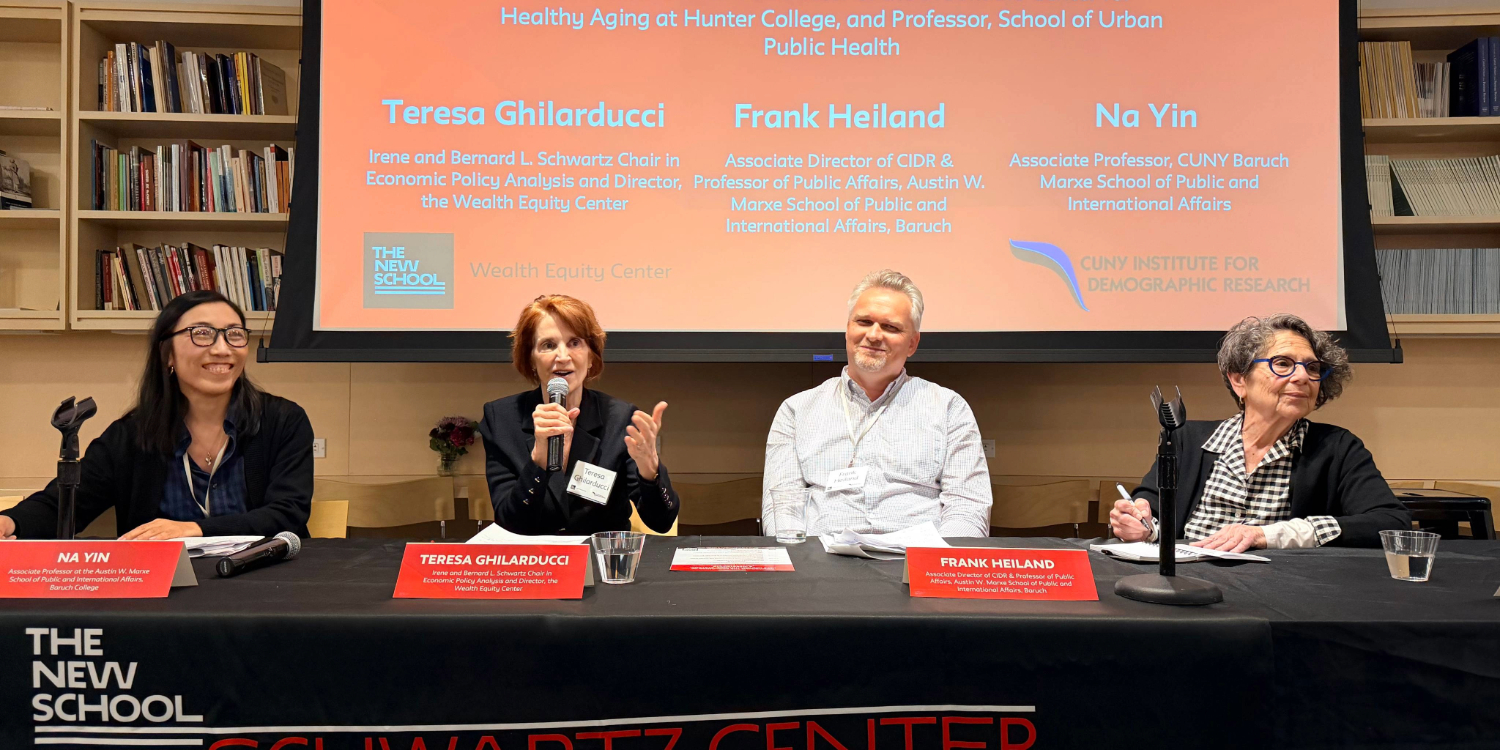
Earlier this month, I co-organized a conference with Karthik Manickam and Drystan Phillips, my fellow PhD Fellows at the New School’s Wealth Equity Center, titled Reimagining the Economics of Late Life: Institutions, Systems, and Investments. Across the day, we heard from established and early-career scholars in a plurality of fields in three sessions focused on: (1) how current systems are failing older adults, (2) the case for investing in late-life systems, and (3) how we might reimagine institutions and policies for an aging society. Dr. Janet Gornick’s keynote explored themes of poverty and inequality across age groups and countries, while the closing roundtable discussion invited the audience into a broader conversation about the political economy of aging, disability, and care.
The theme of care was threaded throughout the day. Whether presenters were asking us to think of older adults as caregivers or care recipients, to examine the undercounted costs of caregiving, to assess paid leave policies and end-of-life care systems, or to generally care for a population often sidelined, care was a palpable and persistent throughline in the day’s discussions. Session after session raised the idea that how we care for our elders in a society is deeply embedded in our understanding of their value and how to value life at later stages relative to earlier ones.
What was clear from the presentations was that we economists can learn a great deal from the sociologists, anthropologists, ecologists, philosophers, and other scholars studying adjacent and related issues. These fields asked us to deepen our thinking on the core assumptions and resulting implications of our methods and frameworks.
Care is a deeply socially embedded activity. To adequately address care within economics, we may need to stretch our concepts of value and interrogate the implications of our tools, like cost-benefit analysis or forensic analysis. Such methods offer approaches to valuation that often explicitly or implicitly conclude that the value of human life at its end stages is less than that at its beginning. In other words, the potential for a lifetime is more meaningful than a life already being lived.
For example, several presentations challenged the idea of older adults as primarily dependents, a framing that can often be found in economics literature. Meredith Slopen’s work on paid leave emphasized older adults as workers and caregivers themselves. Anna De La Paz’s research on food insecurity among low-income grandparents highlighted the extent of informal kin support of grandparents feeding grandchildren that goes uncounted in data. Aida Farmand similarly pushed participants to consider the social reproduction contributions of older adults in the form of volunteer and charity work.
Other papers focused less on the contributions of older adults and provided broader frameworks with which to evaluate the contributions, role, and risks of elders and eldercare. Deborah Rose’s presentation on “care as deferred responsibility” argued that institutions defer caregiving responsibilities onto families who then absorb the risks and inequalities that follow. Kirstin Munro’s presentation on care as a “social ecosystem service” encouraged participants to think about care not as an isolated interpersonal act, but as part of a broader social infrastructure that sustains collective well-being. Such framing allows us to move beyond the direct economic contributions of different age groups and think about how we may value old-age and caregiving socially.
Questions of institutional design of caregiving systems also emerged with presentations on healthcare systems and end-of-life care. Katy Schwalbe’s research on hospital closures in New York, driven by cost-benefit assessments and changing healthcare demand, showed how consolidation and changing healthcare systems can create confusion, delays in care, and worse health outcomes for older adults. Mengting Lyu’s presentation on palliative and end-of-life care explored the tension between a “caregiving imperative” and a “treatment imperative.” Because hospital systems are often financially structured around medical intervention, where diagnostic tests and life-saving therapies bring in revenues, forms of care that focus less on treatment and more on comfort are not profitable and harder to justify institutionally on a profit-basis.
Demographic shifts in the U.S., as well as abroad, have raised similar fiscal concerns, with public discourse asking questions like who will pay for long-term care and whether there will be enough workers to support retirees. In her opening remarks, Teresa Ghilarducci aptly reminded us that investments in aging should not be framed in conflict with investments in children. The classic “the old eat the young” narrative misidentifies the issue as allocating resources, opportunities, and wealth to older generations via public spending at the expense of younger generations. Rather, as Professor Ghilarducci noted, countries that spend more on older adults also tend to spend more on younger people. It was not a matter of trading off investments in the old versus young, but an overall fight for public investment in general.
Economists need a richer conception of value if we are ever to effectively study care. This conference raised a difficult question: what would it mean to value life differently in economics? Feminist economics and political economy traditions attentive to gender have already significantly expanded how economists think about value by foregrounding unpaid labor, social reproduction, and care work long excluded from standard economic measures. The conference suggested that questions of aging, disability, and late-life may require a similar stretching of our conceptual frameworks.
If you’d like to continue this conversation with us at the Wealth Equity Lab, we invite you to join us for our monthly seminar series of the same title, where we’ll get to hear from more scholars on exactly these questions and topics. Read more about it here.
Jessica Forden is a PhD Candidate in Economics at the New School for Social Research and a Fellow at the Schwartz Center for Economic Policy Analysis.
This work is licensed under a Creative Commons Attribution-NonCommercial-NoDerivatives 4.0 International License. Photo by the author.