Rejecting the Poisoned Pie: Feminist Critiques of the Debt Economy
Debt is the technology for making care a private risk rather than a public good. Around the world, feminist researchers and activists are challenging debt’s centrality to social policy.
Feminists have long troubled the divide between public and private — recognizing that domestic labor and domestic violence should not be siloed off from other forms of labor and violence, that care should be considered a public good rather than a private burden, and that public policies intrude upon private lives. Given this history, it is not surprising — but evidently galvanizing — to see household debt emerge as a focal point of feminist critique. A growing social movement highlights the ways that household debt both reflects larger structural factors and renders visible the labor and economic activity it entails.
Social movements protesting the burdens of household debt are not entirely new. When I lived in Mexico in the mid-1990s, two social movements captured the public imagination: the armed Zapatista rebellion in Chiapas and the unarmed El Barzón debtors’ movement that started in rural areas of the western state of Jalisco and quickly spread throughout the country. Both movements are associated with the destabilizing effects of the North American Free Trade Agreement (NAFTA), which took effect in January 1994, and the devastating Mexican peso devaluation in December of that year.
These movements, however, had roots in the 1982 debt crisis that precipitated what became known as Mexico’s “lost decade” and the ensuing neoliberal reforms that formed the Washington Consensus grounded in a fundamentalist faith that market forces could cure all economic ills. Many ordinary Mexicans felt like they were left holding the bag for debts taken on by political and economic elites, as the negotiated terms of debt repayment resulted in precipitous currency devaluations, slashing social services, and skyrocketing costs of dollar-denominated household debt. Suddenly, the risks of sovereign and investment debt were being borne by families, farmers, and small businesses.
The pattern will look familiar to anyone who remembers the 2008 financial crisis. Citibank, which had taken on a particularly risky loan profile but was considered too big to fail, was allowed to delay recognizing the extent of its losses to avoid bankruptcy, while increasingly precarious households struggled to meet basic food, housing, and healthcare needs. And, as the economist Diane Elson explains in a recent interview in a special issue of Feminist Economics, there is a class and gender dynamic at play: “Risk is off-loaded from those who take the risks (mainly high-income men) to women, especially low-income women, who have to absorb the risks because they cannot liquidate their responsibility for their children. Women are called upon to provide a safety net of last resort, especially through more intensive paid and unpaid work, but there is a limit to what they can bear.”
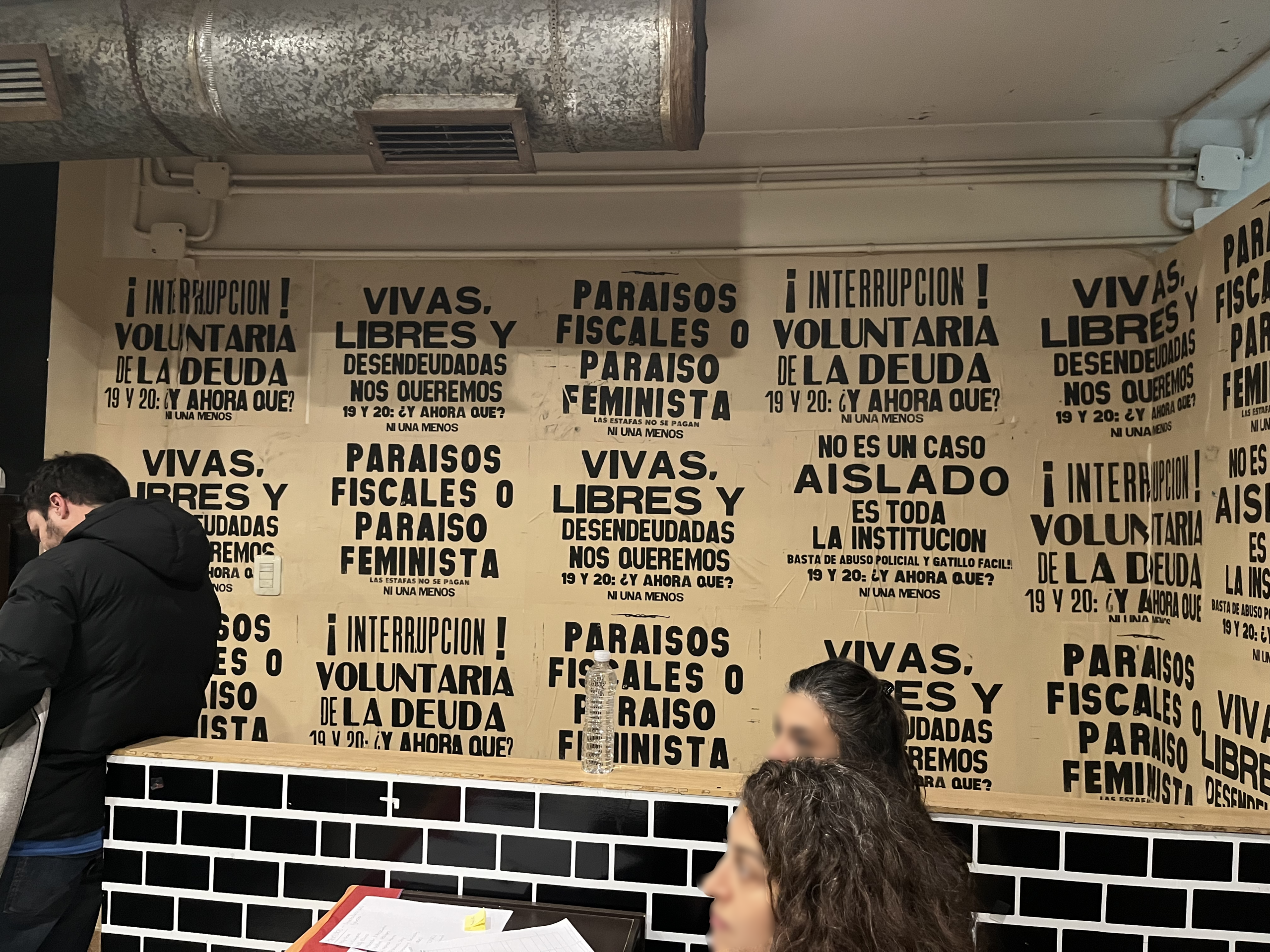
Latin America remains the anti-debt movement’s center of gravity, with Argentina’s Ni Una Menos movement linking this campaign to feminist efforts to combat gender violence, defend reproductive justice, and secure recognition for social reproduction. Debt is as much a part of Argentines’ daily existence as mate and empanadas — a basic survival strategy that allows many households to cover the costs of rent, food, and medicines. (This is not a problem isolated to Argentina — in the United States, people increasingly rely on debt to purchase food.) Signs and flyers demanding debt forgiveness appear throughout Buenos Aires. When Verónica Gago — a political theorist, Revaluing Care board member, and a long-time Argentine feminist activist — invited me to a recent event on “Feminisms against Debt” at the Ni Una Menos HQ, I jumped at the opportunity.
By the time I arrived at the unassuming storefront shared by the Ni Una Menos movement and the Buenos Aires renters’ union, located a short walk from Buenos Aires’s Plaza Congreso to make it convenient for protests, the meeting to discuss feminist responses to debt had already been underway for a couple of hours. Lucía Cavallero emceed a panel of seven lawmakers explaining their parties’ respective strategies to offer relief to households increasingly relying on debt to survive. A reading followed the panel and then, of course, music.
The marathon gathering somehow managed to be serious, intense, light, and joyous all at the same time and drew on an explicitly feminist repertoire of solutions. The opening “financial self-defense workshop” offered practical strategies for fending off predators. The ensuing discussions felt like a consciousness-raising session — recasting a private source of shame as a structural problem demanding a collective solution. The walls were plastered with posters linking debt to campaign for legalized abortion, recognition of reproductive labor, and demands of the Madres de la Plaza de Mayo.
This sustained attention to personal and household debt on its face may seem surprising. After all, Argentina has very low levels of household debt as a percentage of GDP, particularly compared to other countries around the world. However, levels of personal debt have been growing quickly, most notably among young people, and campaigns for financial inclusion have turned into instruments for deepening household indebtedness.
The recent Feminist Economics special issue on gendering the debt crisis reflects these debates, including a contribution by Lucía Cavallero, Verónica Gago, and María Celeste Perosino and repeated citations of Cavallero and Gago’s influential book, A Feminist Reading of Debt. The issue’s editors — Kanchana Rawanpura, Smriti Rao, and Abena Oduro — point to the “financialization of life” through vehicles such as microcredit, platform technologies, and cash-transfer programs that pull women into the orbit of financial services and, quite frequently, into debt.
Elson, who has researched the relationship among gender, development policies, and political economy for nearly a half-century, offers an analysis that draws on decades of lessons about unintended consequences. The gender bonds that UN Women supports, she warns, can become a vehicle for allowing investors to define the metrics of gender equality. When investors define what counts as progress, financing equality through debt turns a public decision into a private contract.
Debt is the technology for making care a private risk rather than a public good. Personal and household debt have become the substitute for the social services slashed during the past four decades, fostering the bolsillos rotos [torn pockets] phenomenon where money enters the household as debt and immediately exits to cover basic needs. Attending to this mounting debt — the care and feeding of the debt itself — has emerged as its own form of reproductive labor that takes a physical and emotional toll on those who perform it.
Forty years ago, just as debt crises and neoliberal responses were taking hold, economists Caren Grown and Gita Sen explained that the lesson they had learned from their research with racially, economically, and nationally marginalized women was that they should reject a development paradigm that left women scrambling to claim a larger piece of a poisoned pie. They challenged triumphant claims that microcredit offered women liberation from coverture practices and discriminatory lending.
Today, feminists warn that “financial inclusion” in all its forms may turn out to be another poisoned pie, drawing women deeper into household debt as a substitute for sound social policies. The feminists in Ni Una Menos learned the lessons from the lost decade of the 1980s, refusing to allow creditors’ demands to take priority over society’s needs. Instead, they organize in solidarity to demand debt forgiveness as a claim on public responsibility for care, not a private failure to be managed one household at a time.
This work is licensed under a Creative Commons Attribution-NonCommercial-NoDerivatives 4.0 International License. Photo by the author.