Caring for the Holidays
Holidays tend to increase stress and labor for caretakers. Distributing those burdens more broadly might better serve the holiday’s main purpose of strengthening social bonds.
From a care economics perspective, the holiday season is … complicated. A seemingly insane amount of resources — time, labor, attention, household finances — go into creating the elaborate ofrendas that pop up in Mexican communities during the week leading up to the Día de los Muertos. Countless hours are spent assembling altars of marigolds, pan de muerto, and candles; careful thought goes into finding the perfect photos of departed loved ones and recalling their favorite foods and pastimes. And then, just as those of us in the United States were holding our breath and waiting for election results, it was all just swept away.
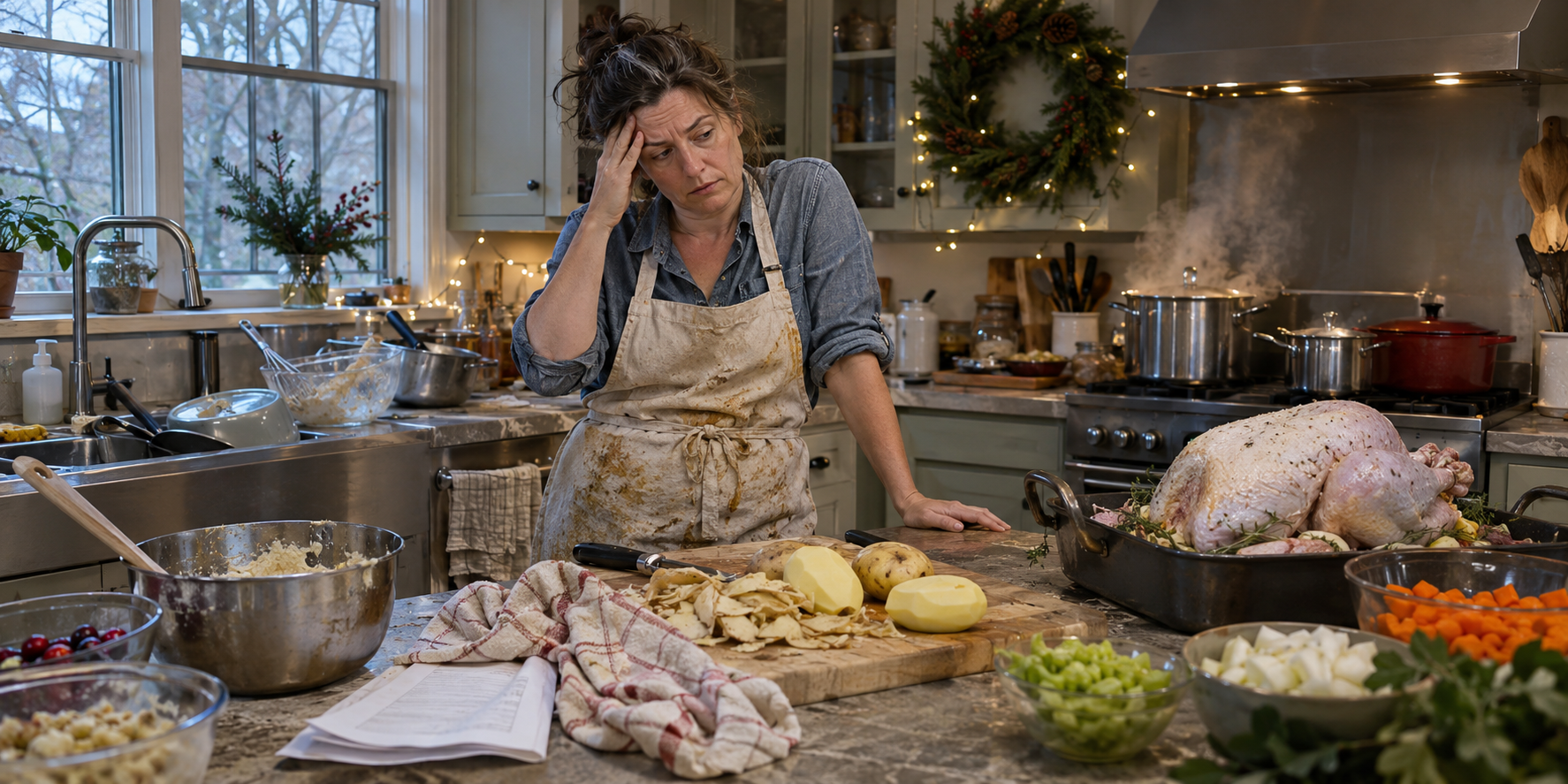
Around the world, holidays of every variety demand a huge amount of effort and attention, mostly from women, to uphold cultural traditions and the social networks they sustain. All this is, to be sure, a form of care — of maintaining the household and community rituals and the social bonds that connect us. But every year I find myself wondering whether it really needs to be quite so exhausting.
Nearly four decades ago, the anthropologist Micaela di Leonardo coined the term kin work — distinguishing it from both unpaid housework and participation in the labor market — to describe “the conception, maintenance, and ritual celebration of cross-household kin ties” that included a whole range of activities to keep up regular communications, acknowledge special occasions, and cultivate relations according to expectations from both within the family and from the broader culture. Apart from the consumption aspects, economists often saw these activities as leisure, but di Leonardo insisted, “The creation and maintenance of kin and quasi-kin networks in advanced industrial societies is work; and, moreover, it is largely women’s work” (442-43).
Like other forms of care, kin work is noticed mostly in its absence: the inattention to the needs of dependents or to the ecological effects of industrial policies, the untended gravesite or the shuttered health clinic. Preventing those lapses depends upon substantial amounts of cognitive and emotional load that falls overwhelmingly to women and girls, particularly mothers, who are tasked with managing schedules and to-do lists so that everything runs smoothly.
Also like other forms of care, substituting market services is often perceived as diminishing the quality of kin work. Much as those who rely on help with daily living activities prefer support from those who know their needs and foibles, and paid childcare is seen as inferior to parental care, appreciation for kin work is often predicated on the exhaustion itself — the extended preparations of meals and decorations, careful attention to upholding particular family traditions, and attention to the complicated dynamics of family gatherings. Households can purchase a pecan pie or a gingerbread house or even hire a party planner, but paying someone else for this labor diminishes the intimacy and affective bonds associated with kin work.
Importantly, kin workers also take pleasure and pride in these activities, and their specialized knowledge and skills regarding relationships, tastes, and traditions confer status within their households and social networks. Familial love often animates all this effort, but, as Nancy Folbre and Julie Nelson remind us, the fact that kin workers are often motivated by love doesn’t mean it’s not still work.
This burden — including labor, anxiety, and task management — becomes particularly acute during holidays, when expectations of upholding both long-held and invented traditions invite scrutiny and seem to raise the stakes of fulfilling these roles perfectly. South Koreans have a term for the stress that women experience during the holiday season: myeongjeol syndrome. Birth weights decline, divorce filings and domestic violence reports surge. Preparations for holidays such as Eid and Diwali add still more to the load of unpaid care that keeps many women out of paid work.
All of this laboring for tradition also shows up in official economic accounts, both because these celebrations drive tourism and because people purchase goods and services to sustain the traditions — all those Diwali candles, Christmas wreaths, and Día de los Muertos calaveras. Mexico’s national confederation of chambers of commerce projected that this year’s Day of the Dead celebrations would generate 53 billion pesos (roughly $3 billion USD) in spending. Yet the rituals and spectacle that drive all this activity in the formal economy depend upon the unpaid, stress-inducing, detail-attending labor performed overwhelmingly by women.
Kin work also plays an economic role that no official account captures — one more explicitly linked to a care economy. Ritual celebrations and informal communications have always played a critical role in maintaining kin and quasi-kin networks that serve as a critical social safety net during crises. From early-modern British “help-ales” to Harlem rent parties, festivities have played a central role in consolidating mutual-aid networks. In a more contemporary context, the imposition of austerity policies has led to greater reliance on these informal networks, which are, in turn, fraying under the pressure of endless demands.
The effects of austerity are showing up all over the world, and they will add to the stress and labor of this year’s holiday season. In the United States, the 2025 budget reconciliation law has left many people without food benefits and unable to afford health care. Meanwhile, draconian immigration policies have made it risky, and for many impossible, for migrants in the United States, including those on valid visas, to travel home to see family.
So, does it all need to be quite so exhausting? Part of the problem is that the exhaustion has become the proof of love: the mole made from scratch, the hours on the phone, the host who never sits down. But what makes kin work valuable isn’t the fatigue; it’s the knowledge of who doesn’t eat pork, which aunt shouldn’t sit next to which cousin, how grandmother made the tamales. Knowledge, unlike exhaustion, can be taught and shared. Economist Diane Elson’s call to recognize, reduce and redistribute care might start there, by treating the kin worker less as a martyr than as an expert whose skills are worth learning. That won’t make the holidays effortless. It might make them less lonely for whoever has been doing the remembering.
This work is licensed under a Creative Commons Attribution-NonCommercial-NoDerivatives 4.0 International License.
Sam
Thank you for this reflection, Jocelyn. It makes me think of my mother. She’s spent so many years doing the exhausting hosting you describe, for our entire extended family, that she can hardly stand by even though, for years now, my siblings and I have tried to take over the burden by dividing up the cooking duties. We talk about her relentless commitment to feeding and hosting her love language, and I’m sure it is, but it’s also work! Great to be reminded of that.
Jocelyn Olcott
Yes, I think this is quite common — my mother was the same way, although she and I really enjoyed cooking together. Some of the anthropological scholarship focuses on the ways this work showcases women’s skills and indispensability. I.e., this is work that many of them are performing in a more quotidian way 365 days/yr, but there are only a handful of occasions when it’s really on display for appreciation and recognition. Still, the stress and exhaustion is really well documented — perhaps a more collective approach could still involve recognition of how much everyday kin work goes into sustaining these relationships and traditions in the first place.