Researching and writing about care while trying to care for yourself… without dying in the process
Amada Aurora Vollbert Romero
17 June 2026The dilemma of writing about care work while being unable to care for oneself due to structural issues such as exploitation — or, in this case, the self-exploitation we are forced to endure in order to survive —i s one of the major contradictions we face as researchers engaged in revaluting this type of work.
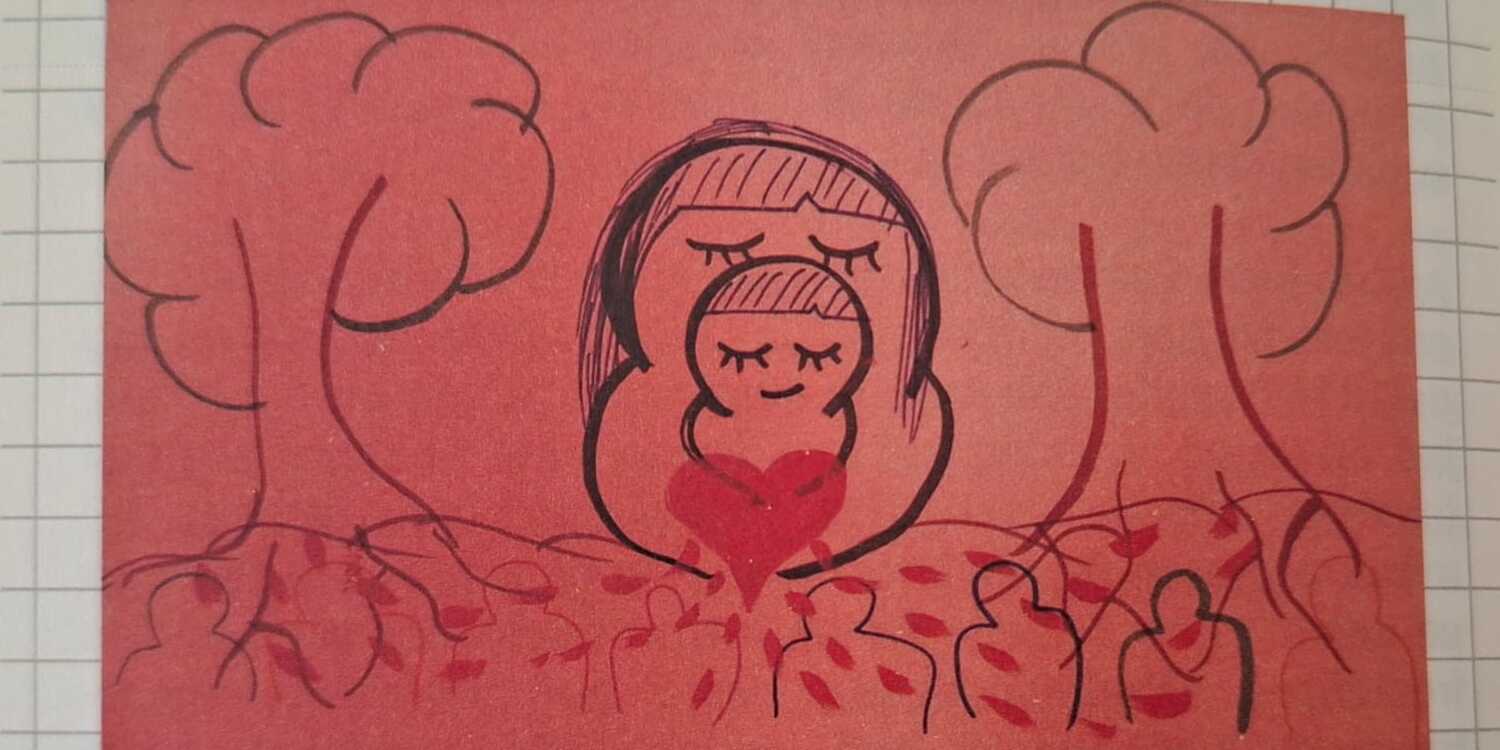
Concepción Arredondo de Rivera, a Mexican anarchist who was active in the Magonist movement during the Mexican Revolution, died on September 11, 1913, from a stomach ailment that, according to some sources, later developed into a form of cancer. Concha de Rivera, as her closest friends called her, not only participated actively in the revolution but also is known for having run the Magonist movement’s communal kitchen until her final days. Such is the irony of her story that a question immediately comes to mind: Why did the woman who fed the revolutionaries die precisely from a stomach ailment?
I ask myself this question as I recover from nervous gastritis I developed a few weeks ago due to overwork; as a teacher and researcher living in a small city in the Global South, I have to juggle several jobs at once to pay the rent, buy groceries, and care for my life partner, Guaje. In my current situation, I teach a couple of classes at Vasconcelos University of Oaxaca (UNIVAS), do freelance research, help out at one of my friend’s art stands, and sell things online — from clothes I no longer wear to dishes my partner cooks on the weekends. Even so, I know my situation is privileged because I can be somewhat flexible with my time — or at least that’s what I tell myself when I see how little money my four jobs manage to bring in whenever I can’t make ends meet.
That’s why the tension between writing about self-care and being unable to take care of yourself due to structural issues like exploitation — or, in this case, the self-exploitation we’re forced to endure just to survive — is one of the major contradictions we face as researchers reevaluating this type of work. But it doesn’t end there, because we know it’s not simply a matter of taking care of ourselves in and of itself; it’s not about doing our famous skincare routine before bed after spending eight hours in front of screens and saying, “There, I took care of myself!” Rather, it’s about building communities and care networks that allow us to carry out our activities without risking getting sick or, worse, ending up like our beloved Concha.
One of the Magonists who understood this very clearly was María Brousse Talvera, Ricardo Flores Magón’s life partner. This revolutionary from Zacatecas knew how to build alternative forms of family through extended networks of care and child-rearing, through which she managed to raise her daughter Lucía Norman without abandoning her revolutionary ideals and practices. It is interesting that María, although she lived in an era when criticism of care work as unpaid labor had not yet emerged, engaged in reflective practices on the subject as a staunch advocate of free love. It is very likely that this critical stance toward affections was what led her to consider the need to distribute the burden of care, and if we recall Silvia Federici’s famous phrase “what you call love is unpaid labor,” we can see that love and care have been closely intertwined throughout history.
This is one of the reflections with which I opened my article titled “Caring for the Revolution to See It Flourish: The Knowledge-Practices of Anarcho-Magonist Women as a Feminine Politics”, for interpreting historical moments through the lens of care — in this case, the Mexican Revolution — confronts us with the need to understand the possible parallels between care and other ideas. In other words, it becomes necessary to understand that perhaps many of the actions taken by Magonist women toward the Magonist movement were conceived from that perspective: love for the revolution, love for their comrades, love for the cause, and so on. This does not make it any less relevant or worthy of research; rather, it shows us that affections are a fundamental strand of care work, and this gives these practices an emotional dimension.
I suppose that is why I feel so deeply moved when I conduct research on this topic, because care work permeates life in every way, and it becomes impossible not to question the ideas and practices that we ourselves are weaving to look after one another. Without care, the great caudillos of the Mexican Revolution would not have existed; without care, the Magonist movement could not have sustained itself when its leaders were imprisoned; without care, the national and international networks that supported the militant newspaper Regeneración would not have endured; without care, I would not be able to write this blog post today. It is care—understood as the mundane work sustained through the embodied practice of daily life—that allows us to go beyond mere survival and live with dignity.
That is why, even though I know I still lack sufficient collective care structures to sustain my life in that dignified way, I tell myself: “fake it till you make it!” — because every day I work within networks of mutual care through which I hope, in the future, to continue building the dignified life I desire. After these weeks of reflection on trying to take care of oneself while researching and writing about care, I think that, beyond the demand for individual self-care — to which working-class women do not have access because it is conceived in terms of consumption — the will to build that future of collective care we want to live must flourish within us all.
This work is licensed under a Creative Commons Attribution-NonCommercial-NoDerivatives 4.0 International License. Image from a fanzine created by the author in collaboration with the Rosa Luxemburg Foundation. The full fanzine, Las Magonistas: Revoluciones, is freely available on the Foundation’s website.