The Care Economy Revolution
Jocelyn Olcott
25 November 2025Two very different projects argue that the care economy could bring about the end of capitalism as we know it.
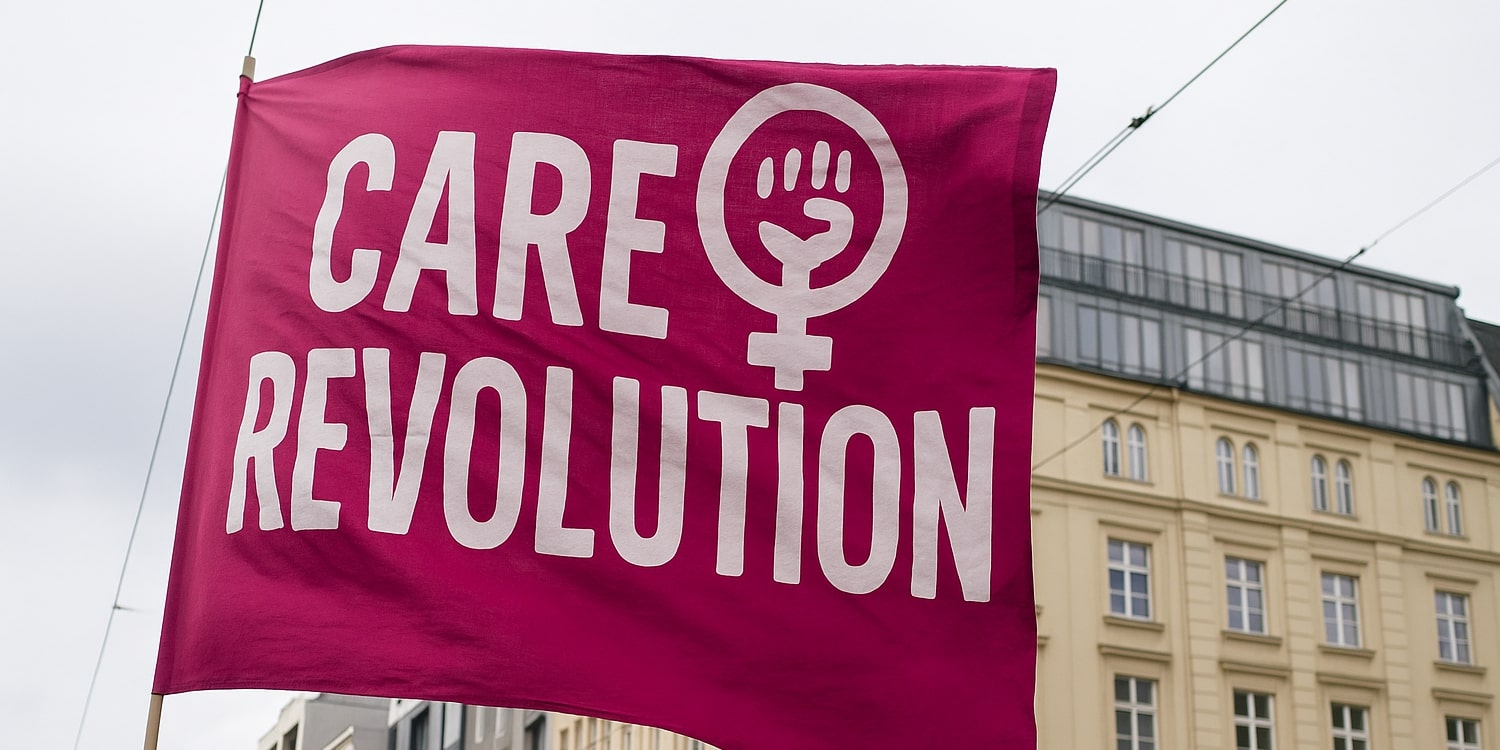
Whether it’s kismet or zeitgeist, I attended two events on Thursday that — from very different ideological positions — linked a flourishing care economy to the fall or at least radical reimagination of capitalism. One approach suggested that the house of capitalism needed to be taken down to the studs while the other argued for burning it down, but they agreed that redefining care as a public rather than a private good has far-reaching implications for the current capitalist system.
The first event was hosted by a standard bearer of liberal internationalism, the United Nations Research Institute for Social Development (UNRISD). Under the auspices of the Just Transition project focused on “equitable and sustainable climate and environmental policies,” the Just Transition and Care (JTC) team presented the results of four-year research collaboration to develop a set of recommendations for both waged and unwaged care work in the areas of social care in domestic and community spaces, peasant and indigenous food provision, environmental care, healthcare, and education. The full report includes a chapter dedicated to each of those areas as well as an introductory framework and a closing set of policy recommendations.
When Stefania Barca, the JTC founder and one of its coordinators, introduced the report during Thursday’s webinar to launch it, she stressed that a care-centered just transition “requires a decisive step away from the capitalist system and culture.” The JTC report highlights the social and environmental predations of “a capitalist culture that treats nature and human labour as disposable inputs” (64). Over four years, the JTC team conducted a series of webinars that included paid and unpaid care workers in different sectors, activists in these areas, and academic researchers to listen to and facilitate the discussions.
The webinar reflected the ambitious scope of this research project — including perspectives from around the world and from different sectors of the labor movement. The discussion exemplified the JTC’s concern that the Just Transition project and the labor movement had remained narrowly focused on industrial jobs in the formal sector and tended to ignore the importance of care work in the informal and unpaid sectors. David Boys, recently retired from Public Services International, highlighted the critical role played by service-sector labor unions, while Nina López spoke for the Wages for Housework / Global Women’s Strike movement.
Devan Pillay trotted out the standard litany of concerns about the “unintended consequences” of paid care proposals: that they would reinscribe both the maldistribution and the undervaluation of care labor. Arguing instead for a universal basic income (UBI), Pillay believes that this solution will result in “shared care rather than paid care.”
Several panelists contested Pillay’s representation, pointing out that compensating care work would provide many women, who perform most care labor, with increased household bargaining power. López pointed to a host of local, targeted basic income programs focused on care provision. Barca explained that paying carers — much like paying teachers — constitutes a recognition of care as a public good. Rocío Hiraldo, a member of the JTC research team, pointed out that sharing and compensating care labor are not mutually exclusive.
I was mulling over the JTC webinar, thinking about how to capture the debates here, when I attended a talk that evening by political theorist Jodi Dean about her newest book, Capital’s Grave: Neofeudalism and the New Class Struggle. An unwavering Communist, Dean sees the “party form” as the only entity that can have the leverage and focused sense of purpose to meet the current challenges. While the JTC team labored to “avoided reproducing top-down agendas and dominant assumptions around care work, as well as around the transition itself” (15), for Dean strong leadership offers to only means for an effective challenge to pervasive and invidious forms of capitalism.
Seeing the service-sector as the basis of an economy oriented toward human flourishing, Dean calls not for a UBI but rather for universal basic services. In her rendering, service workers constitute the new revolutionary vanguard for emancipatory politics. “Communists should place the provision of universal basic services at the core of our vision for the post-capitalist future,” she explains in her LitHub excerpt. “Reindustrializing is not a serious option: the environmental costs for such a strategy on a global scale are far too high. A more promising path toward economic viability comes from services.” Caretakers of all kinds — teachers, nurses, parents, sanitation workers, food preparers, environmental activists — play such a critical role in our quotidian lives that they can exert political leverage if they are sufficiently organized.
Dean concedes that this imaginary cannot really address the maldistribution of care labor around the world and admits that it may seem “somewhat fanciful” to believe that we are close to achieving a world in which care provision is not restricted by various forms of belonging, such as citizenship or union membership. Still, her insistence on the revolutionary potential of the care economy offers a generative provocation.
Despite their evident ideological differences, these two interventions have some common ground. Both frame this as a conjunctural moment precipitated by social and ecological precarity — a decisive turning point in which, as the JTC report puts it, we have “an unprecedented historic opportunity to re-orient ecological transition policies towards the satisfaction of the largely unmet care needs of both people and the planet” (3). Both understand the public goods of the care economy to include ecological as well as social care; they stress that a care economy would be greener both by recognizing the value of environmentally conscious economic activities and by making environmentally friendly care services more appealing as livelihoods. Both these visions depend upon a strong and well-functioning state, albeit to different degrees.
Both Capital’s Grave and the JTC report start from the widely shared recognition that the hyperexploitation of both human labor and natural resources cannot continue unchecked. They also both offer hope that, by reimagining care in all its forms as a public good, we can build a world that is not only more livable but that fosters both human and non-human flourishing. If such utopian ideals are, as Jodi Dean allows, “somewhat fanciful,” they also are indispensable.
This work is licensed under a Creative Commons Attribution-NonCommercial-NoDerivatives 4.0 International License. Photo based on Care Revolution Netzwerk