The Care Tide: Laying the Foundations for Transformative Policies in Latin America
Jocelyn Olcott
27 August 2025A hard-fought campaign to recognize care as a human right has scored some important wins this month.
Latin American political moments are often described as waves. The 2000s brought a Pink Tide of center-left (but not communist) governments to power through much of the region. More recently, the Green Tide earned its name from the massive demonstrations of feminists wearing green bandanas to demand reproductive justice and protest gender violence. There certainly is a care wave washing over the region, as the articles in a recent issue of Social Politics demonstrate, even if hasn’t been assigned a color yet.
The recent advisory opinion from the Inter-American Court of Human Rights (IACHR) recognizing care as a human right spotlights the extent to which Latin America is leading the world in redefining normative values around care as a human right. Although the opinion raises questions about the gap between de jure and de facto rights to care, it demonstrates both the ways that the care framework has gained traction in Latin American law and policy and the influence of feminist intellectuals and of the United Nations — UN Women in particular — to establish the terms of the care agenda.
The campaign for care as a human right has been building for nearly two decades, arguably launched by Laura Pautassi’s paper published by Economic Commission on Latin America and the Caribbean (ECLAC/CEPAL), which laid the groundwork for bridging between established human rights conventions — including not only the Universal Declaration of Human Rights but also others such as the Convention on the Rights of the Child and Convention on the Elimination of All Forms of Discrimination Against Women (CEDAW).
Defining care as “the set of actions necessary to preserve human well-being, including assistance to those who are in a situation of dependency or require support, whether temporary or permanent,” the IACHR’s opinion centers gender equality as a human-rights priority and calls for the recognition of the right to care, to be cared for, and to provide self-care.
The campaign for care as a human right laid the groundwork for a host of constitutional and legislative reforms that aim to translate principles into practice. As Uruguayan political scientist Belén Villegas Plá demonstrates in her recent review of care-related legislation in the region, the past decade has brought a dramatic set of legislative developments, starting with Uruguay’s Sistema Nacional Integrado de Cuidados (SNIC, National Integrated Care System) in 2015 and accelerating as the Covid-19 pandemic revealed the deepening crisis of care. These efforts build upon the Pink Tide governments’ attention to poverty and inequality but address critical issues of gender inequality that these governments often ignored or even exacerbated. In 2022, the Interamerican Commission of Women produced model legislation for a National System of Care.
It is no accident that this critical step in establishing normative expectations has emerged from Latin American jurisprudence. Three important contextual factors explain this development. First, Latin American countries have constitutions that obligate states, in contrast with constitutions, such as that of the United States, which restrict them. In both cases, of course, the obligations or restrictions are only as strong as the political force behind them, but Latin America’s legal and political cultures reflect this difference. Both the IACHR’s advisory opinion and national legislative reforms place an obligation on states to recognize and rectify failures in care provision.
Second, the United Nations and its agencies have long had a strong regional presence, certainly by comparison with the United States and Europe, and have played a significant role in setting human rights standards. Women’s groups leverage instruments such as CEDAW to make demands on local and national governments. ECLAC/CEPAL just this month reaffirmed its commitment to gender equity and a care paradigm. Both judicial and legislative discourses reflect ideas promulgated through UN Women: adding Reward and Represent to Diane Elson’s original Recognize, Reduce, and Redistribute paradigm (the 5Rs framework) and taking up Shahra Razavi’s call to redistribute care around the care diamond of states, markets, families, and community.
Third, Latin America has a vibrant, mobilized, and often militant feminist movement that, particularly with the spread of the Ni Una Menos movement over the past decade, has built a transversal movement linking the recognition of care and the right to care with demands to end gender violence and to recognize gender diversity. Massive demonstrations and labor stoppages occur throughout the region, particularly on two UN-designated days: International Women’s Day (March 8) and the International Day for the Elimination of Violence against Women (November 25),
The Latin American cases, which include many variations in how they conceptualize a care agenda, offer models for how countries in the Global North might imagine a more expansive concept of care policies. While countries with more robust systems of social protections resembling those of the United States or Europe have developed human-centered care proposals, countries such as Colombia have included non-human aspects of care, including the natural environment as well as cultural traditions and community formations. Emphases in legislative frameworks reflect national cultures and histories, such as anti-racism campaigns in Brazil and indigenous rights in Mexico and Colombia.
Advocates for both judicial and legislative measures recognize that these reforms are necessary but not sufficient. First, passing laws or even amending constitutions hardly guarantees changes on the ground. The proposed amendment to the Mexican Constitution to establish a National Care System would amend Article 4, which has stated since 1974 that men and women are equal before the law. The very fact that another amendment is needed underscores the fact that changes can play a critical role in shaping normative values but rarely transform practices.
Second, as we’ve seen with the current governments of Javier Milei in Argentina and Donald Trump in the United States, regime change can result in rapid reversals of seemingly secured rights. (Indeed, the IACHR had to override Milei’s effort to withdraw the previous Argentine government’s petition to declare care a human right.) Even in governments advocating for a right to care, ambivalence among legislators can leave measures bogged down in the political process. Both Chile and Mexico, for example, have seen major national reforms pass overwhelmingly in their Chambers of Deputies only to stall out in their Senates.
Finally, resource constraints often make it difficult for even committed political leaders to realize a right to care. And those who may be in greatest need to demand the recognition of a right to care — dependent humans, polluted rivers, vanishing languages — are least likely to be able to make that demand on their own behalf. As Pautassi explains, “Most human rights instruments envisage the gradual realization of the content of rights and consider the constraints arising from scarcity of resources or deficits in State capacities. Nevertheless, they also establish obligations with immediate effect that link the standards among them and oblige to guarantee the minimum content, at least, of each right” (7)
These challenges only highlight, however, the importance of learning from Latin America’s more expansive approach to a care society. Care policies in Latin America have emerged from an economic context characterized by high levels of informality and commodification of household labor. Whereas US care policies largely rely on employer-provided welfare benefits, Latin American governments start from the more precarious, casualized, and gig-driven labor markets that now feel familiar in the United States. The Latin American models also more often recognize that care for human society is inextricable from care for infrastructures, cultural traditions, and natural environments. Perhaps more importantly, establishing care as a human right takes a critical first step to implement policies and practices that recognize a tripartite right — to care, be cared for, and to self-care — as fundamental to all people regardless of their social position or participation in labor markets. It distributes responsibility for upholding this right around the care diamond and across all demographic groups, and it and extends the protections of care beyond human society to include the non-human resources that sustain human flourishing.
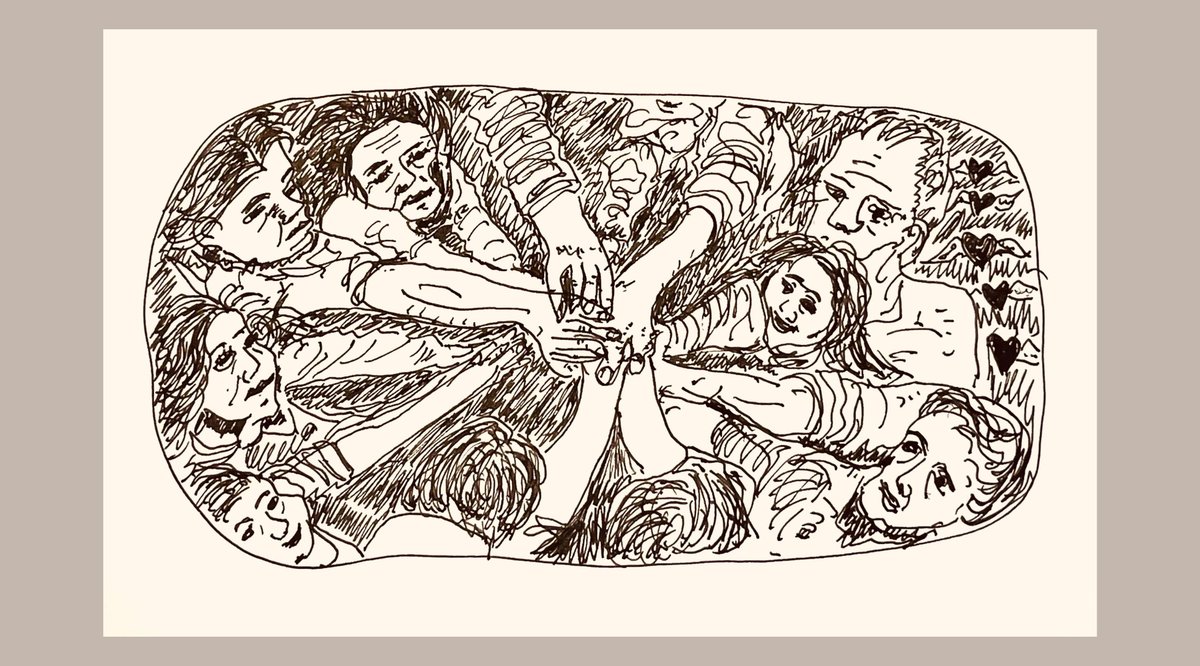
Artwork by Nancy Folbre This work is licensed under a Creative Commons Attribution-NonCommercial-NoDerivatives 4.0 International License.