The Activist Intellectual Legacy of Eileen Boris
Jocelyn Olcott
28 January 2026Eileen Boris’s retirement conference looks toward the future of the history of care work.
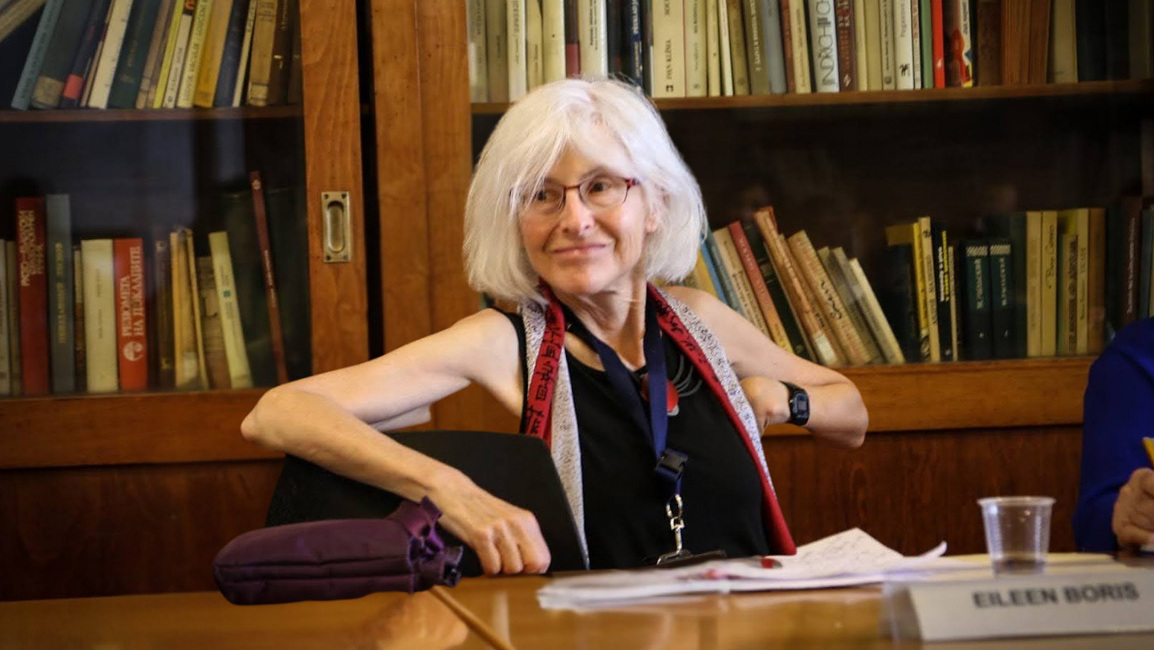
I know this won’t get me any sympathy points, but the east coast ice storm left me stranded in Santa Barbara, California, where it was about 72ºF (22ºC), sunny all day, and so breathtakingly beautiful that it’s a miracle than any research at all happens there. I was in Santa Barbara for the retirement celebration of the remarkable career of the inimitable Eileen Boris, a historian by training and badass feminist intellectual by conviction.
I’m guessing that a lot of Care Talk readers already know Eileen’s work, whether from her earlier work on industrial homework, her co-edited volume on intimate labors, her co-authored book on home health aides, or her most recent monograph on women’s fight for labor standards at the ILO. (Believe me, I have not even scratched the surface of her impressive list of pathbreaking publications.) If you have not encountered her work, you’re in for a treat. I often feel like she’s already gone out and dug up answers to questions that I’ve only just figured out how to ask.
For historians, Eileen led the way in understanding the relationship between home and work — between social reproduction and wage labor, between intimacy and commerce, between the domestic and the transnational — in deeply contextual ways. Her scholarship has moved the field so far that it’s almost (but not quite) impossible to remember that all this labor was once considered outside the realm of labor history. She is also a force of nature. Several conference participants insisted that they had proof that she could be in two places (even on two continents) at once. Given her career-long productivity, it’s a bit daunting to ponder how much she will write now that she will be unburdened from teaching and service commitments.
Eileen and I have an ongoing congenial argument about the terms care versus social reproduction. I find the term care more capacious — including non-social forms of care such as the ecological and cultural care that are central to the Revaluing Care project — and more attentive to forms of labor that are not in the service of capital accumulation. I also just think it’s easier to build a campaign around calls for care rather than the more esoteric term that requires at least passing familiarity with Marxist feminism. For an excellent version of Eileen’s counterpoint, see the “Household Matters” article that she co-wrote recently with historian Kirsten Swinth.
The conference in her honor brought together collaborators and former students — all of whom stressed the ways that their research spoke to pressing social issues, often in dazzlingly creative ways. (Carly Thomsen’s “Reproductive Justice Mini Golf” project perfectly captures this intellectual activism leavened with a healthy dose of playfulness.) Several presenters pointed to what they described as the “Eileen methodology” of always learning from the people they write about, often inviting the subjects of these studies to have a hand in shaping the research agenda.
I won’t march through every paper on the program, which included a lot of bold-faced names in our field who took to heart Eileen’s exhortation to present what they are working on now. Taken together, they offered tantalizing glimpses of the authors’ analytical processes as well as where the field is heading — including strong influence of Black Feminist Theory, continued critical engagement with the history of capitalism, and a curiously large number of biographical projects on little-known subjects .
Eileen’s insistence — tell us what you are working on now — fostered a conference that illuminated pathways forward rather than dwelling on a retrospective about Eileen’s own impressive corpus of scholarship. As in so many other ways, even in her retirement celebration Eileen offered a model of engaged feminist intellectual activism.
This work is licensed under a Creative Commons Attribution-NonCommercial-NoDerivatives 4.0 International License. Photo from conference website.
Eileen Boris
I’m touched by this and so happy you were there. Now for care vs social reproduction, I do use both, after all, we called the book Caring for America, not Social Reproducing for America, but hey, maybe we need a book by that name for the Americas! Seriously, let the discussions continued on care as act and affect, social reproduction as a structure, and neither as dichotomy.