The First 1,000 Days of Life Are the Real National Security
What if early childhood care is the key to preventing violent conflicts?
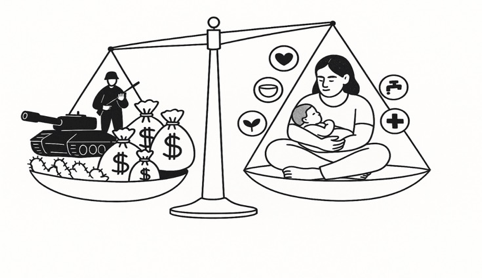
The frontline isn’t always where bombs fall. More often, it is where a caregiver rocks a child to sleep. Security is built in caregivers’ arms.
I first glimpsed this truth not in a classroom, but in a mud-walled clinic in rural Ethiopia. At the start of my career, I travelled across the country with a big international NGO I was working for at that time, tracking malnutrition recovery rates. The data looked solid, until I noticed a pattern the numbers didn’t show.
Children whose mothers stayed through the full treatment cycle healed faster. Their weight rebounded. Their energy returned. They went home sooner. But many mothers couldn’t stay. Other children waited. Husbands expected them back. Firewood needed gathering. Those children recovered more slowly, not because of inadequate treatment, but because presence was fractured.
At the time, program budgets made no space for caregivers. No meals. No transport. No corner for a mother’s labour. That gap delayed recovery, strained staff, increased cost, and undermined trust. When basic caregiver support was finally funded, everything changed: faster healing, fewer relapses, greater dignity.
That field lesson reshaped my understanding of peace. If caregiving support can shorten the duration of illness by weeks, what might it do for empathy, stress regulation, or social trust? What if caregiving is not just private labour, but upstream peace infrastructure?
Years later, I heard that lesson echoed in Afar. After Ethiopia’s Pretoria Agreement in 2022, I sat with elders who had clashed with neighbouring Tigrayan communities. I asked what peace meant. One said, “We want to sell goats again. We want to feed our children.” I told him that trade could resume. He shook his head and said, “That agreement didn’t happen here.” Paper peace collapses when the relational foundation is missing.
We’ve spent billions securing borders, deploying troops, and negotiating peace agreements. But what if the real frontline for national security starts long before conflict, inside the womb, in the first cry, in the arms of an overstretched mother?
We don’t talk about the first 1,000 days of life as peace infrastructure. We should. Because that’s when stress embeds in the body. When trust either forms or fractures. When future conflict takes root or doesn’t. These are the human foundations of security. If we’re serious about conflict prevention, then it’s time to fund caregiving like we fund security.
What the Research Now Confirms
Science is catching up to what caregivers have always known. The first 1,000 days of life, from conception to a child’s second birthday, are foundational not only for physical growth for the capacities that underwrite social peace- empathy, emotional regulation, and stress buffering.
Research from the Harvard Center on the Developing Child shows that excessive early stress without supportive caregivers can leave stress response systems overly reactive or slow to shut down, altering brain circuits and weakening self-regulation. Supportive, responsive relationships, especially early, can prevent or even reverse these effects.
The CDC’s work on Adverse Childhood Experiences (ACEs) shows how early trauma links to chronic health problems, mental illness, substance misuse, and broader community instability across the life course, while emphasizing that prevention is possible.
A landmark systematic review in BMJ Global Health confirmed that early childhood development (ECD) interventions, including parental support, psychosocial care, and early learning, can reduce the risk of family and school-based violence and strengthen resilience in fragile settings.
The Early Childhood Peace Consortium (ECPC), based at Yale, centers early relational health and nurturing care as core to sustainable peace, not secondary.
Why Peacebuilding Keeps Missing It
Despite growing evidence, most peacebuilding strategies still focus on institutions, agreements, and post-conflict recovery. All of that matters. But few ask how caregiving environments condition a child’s capacity to build trust, resolve conflict, or navigate differences before violence ever erupts.
Global agendas often mention human development, yet rarely give early caregiving the priority or structure it needs. They start late, track broad outcomes, and miss the formative layer of early relational care. So, interventions often chase symptoms instead of root causes.
It’s not the table or the agenda that builds peace. It’s the people sitting at it.
Post-conflict mediation matters. Pre-conflict diplomacy matters. But outcomes are set by the people in the room; their stress thresholds, empathy wiring, conflict histories, and relational capacities. Those are shaped long before any peace agenda is drafted.
Reframing the Infrastructure of Peace
These insights now shape my research at Duke University, where I’m developing the Peace Precedence Model, a framework that treats early caregiving as foundational peace infrastructure.
The first 1,000 days offer a uniquely sensitive window, but the model doesn’t stop there. It weaves developmental neuroscience, feminist care ethics, and trauma studies to argue that caregiving systems, relational, structural, and policy-based, must be centred across the life course if we’re serious about prevention and durable peace. This isn’t just theoretical. It’s practical. We already know that caregiver support shortens malnutrition recovery times.
Now we must ask- what if it also reduces intergenerational trauma, strengthens trust, and prevents cycles of conflict?
Caregiving isn’t a silver bullet. Without safety, livelihoods, the rule of law, and inclusive governance, early care alone cannot hold peace. The claim is not a replacement, it is precedence.
What We Measure Is What We Build
Governments are now facing post-war reconstruction bills on the order of US$53 billion in Gaza & Westbank alone, according to the World Bank. That is roughly US$25,000 per person (illustrative of the scale of post-conflict costs). By contrast, in the United States, public investment in early care and education totals just US$1,500 per child during the first five years of life, per The Hamilton Project. That’s roughly 17-to-1 when you compare one person’s post-war repair cost to one child’s five-year early-care investment.
We need a system that treats caregiving not as “social spending,” but as structural prevention, a firewall against roughly a US$20 trillion in global economic impact of violence each year, according to the 2025 Global Peace Index. The truth is simple, but inconvenient- we don’t track what we don’t value. And in most peace indexes, caregiving remains invisible.
That means building mechanisms to test every budget line or treaty clause against its downstream effects on caregiving equity, public trust, and collective stress resilience, because every public dollar cut from early care today adds exponential risk to tomorrow’s security systems.
The message is clear- neglect the first 1,000 days, and you plant the seeds of conflict.
Four steps to make care visible in peacebuilding:
- Pilot Care Impact Notes in two peace, recovery, or budget processes. These are short, policy-facing tools modeled on Peace & Conflict Impact Assessment. They’re designed to test whether a proposed agreement or financing plan could unintentionally disrupt caregiving systems. If care is at risk, the plan gets revised before signing.
- Earmark 5% of Disarmament, Demobilization, and Reintegration (DDR) and peacekeeping funds for caregiver support and Mental Health and Psychosocial Support (MHPSS)in the first 24 months post-conflict. The Inter-Agency Standing Committee has emphasized MHPSS as essential in emergencies, yet caregivers, often the ones holding families together, rarely receive direct support in post-conflict budgets.
- Add two indicators, caregiver stress and early care access, to at least one national peace index or dashboard. UNICEF’s Nurturing Care Framework already guides tracking caregiving environments, yet most peace indexes still ignore them. When care is invisible, so is risk. These metrics make the caregiving environment legible to decision-makers.
- Launch the Care as Peace Alliance, a global coalition to push care into peace policy, funding, and metrics, fast. For example, this alliance could unite researchers, donors, governments, and grassroots leaders to ratify the vision behind both core human rights covenants, the International Covenant on Civil & Political Rights (ICCPR) & International Covenant on Economic, Social & Cultural Rights (ICESCR). Today, we treat civil rights as urgent and social rights as negotiable. But hunger made by policy is as wrong as torture. When care, health, and housing are deferred, the harm repeats. If prevention is the goal, care must be a right now, not a promise for later.
Because the core theory is simple, a community’s ability to manage stress without escalating to violence is shaped upstream, by the resilience and equity of its early caregiving ecosystems.
No peace index tracks lullabies, feeding routines, or caregiver stress. We count GDP and ballots, but not the relational ecologies that wire communities for trust or fear. The frontline isn’t always where bombs fall. More often, it is where a caregiver rocks a child to sleep. Protect that moment, and you protect what follows.
This work is licensed under a Creative Commons Attribution-NonCommercial-NoDerivatives 4.0 International License.
Alex Rose
Thank you for your excellent contributions to this field Tibeb. Your combination of experiences, disciplines and expertise is creating new insights and lessons for peacebuilding in the most tangible and influential sense. Thank you for the work you’re doing on this!